 090003 25483
 Yashoda Hospitals Hitec City Hyderabad, Kothaguda, Telangana 500084
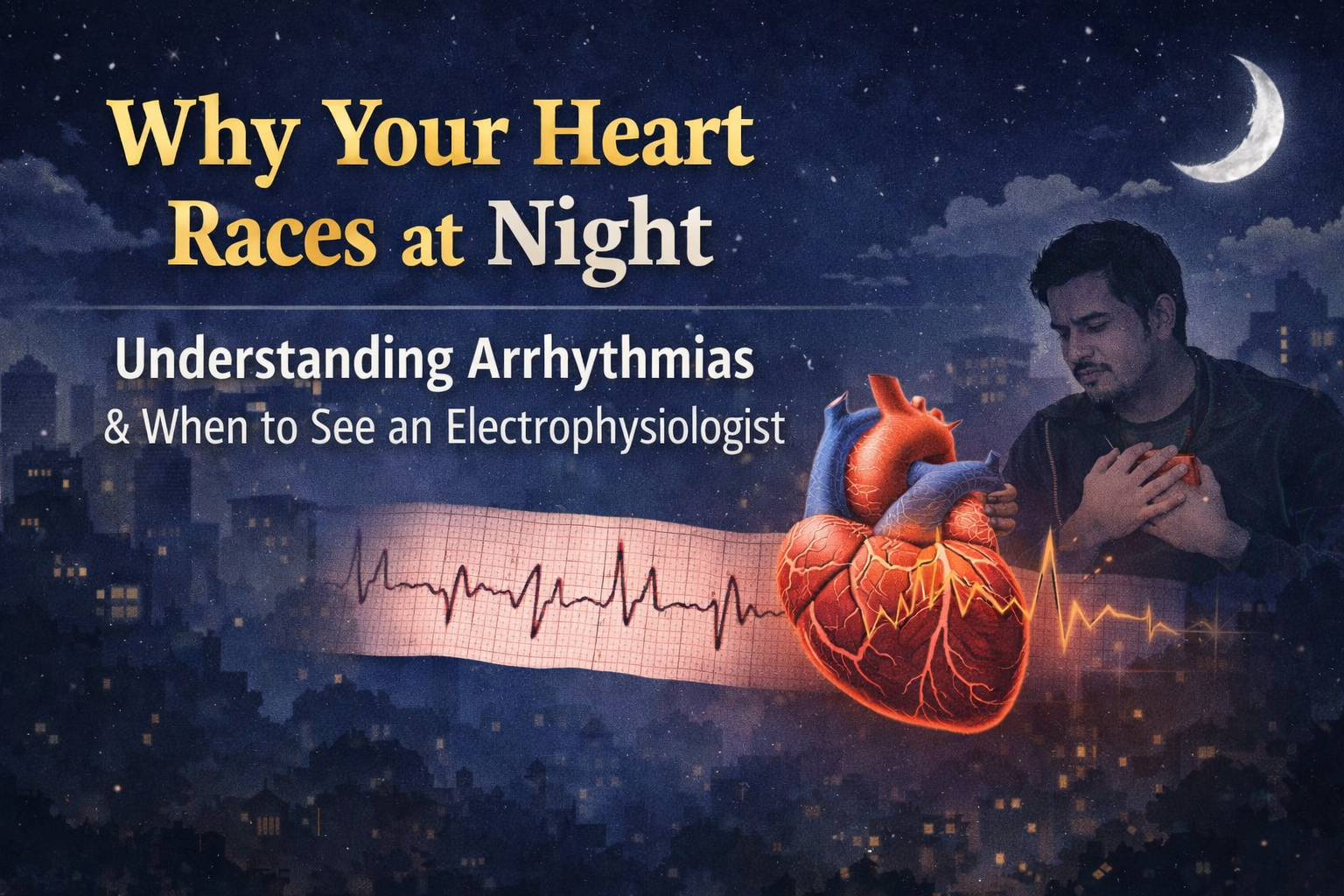
It’s 2:17 AM.
The room is silent.
But your chest isn’t.
Suddenly, your heart feels like it’s racing, pounding, fluttering—or skipping beats. You sit up. You check your pulse. You wonder:
Is this anxiety? Stress? Or something serious?
Night-time heart racing is one of the most common yet most misunderstood symptoms patients report. While many causes are harmless, some may signal an underlying arrhythmia that needs expert evaluation.
In this blog, we’ll break down:
-
Why heart palpitations feel worse at night
-
The difference between normal heart rhythm and arrhythmias
-
Dangerous vs. harmless symptoms
-
When you should consult an electrophysiologist
-
Treatment options available today
Let’s understand what your heart might be trying to tell you.
Why Does My Heart Race More at Night?
There are several reasons why palpitations feel more noticeable after dark:
1️⃣ Fewer Distractions
During the day, your brain is busy. At night, when everything is quiet, you become more aware of your heartbeat. Even normal heartbeats can feel amplified.
2️⃣ Body Position Changes
When you lie down, especially on your left side, the heart moves slightly closer to the chest wall. This can make beats feel stronger.
3️⃣ Stress Hormones
Evening anxiety, overthinking, or unresolved stress can trigger adrenaline release—leading to temporary heart racing.
4️⃣ Underlying Arrhythmias
Sometimes, night-time racing is not just awareness—it’s a true rhythm disturbance.
And that’s where understanding arrhythmias becomes important.
What Is an Arrhythmia?
An arrhythmia is an abnormal heart rhythm. Your heart normally beats 60–100 times per minute in a regular pattern. This rhythm is controlled by electrical signals generated by specialized cells.
When these signals become abnormal, the heart may:
-
Beat too fast (tachycardia)
-
Beat too slow (bradycardia)
-
Beat irregularly
Let’s understand the common types.
Common Arrhythmias That Cause Night-Time Racing
1️⃣ Atrial Fibrillation (AFib)


Atrial Fibrillation is the most common sustained arrhythmia.
In AFib:
-
The upper chambers (atria) quiver instead of beating properly.
-
The rhythm becomes irregular and often fast.
-
Symptoms may worsen at night.
Symptoms:
-
Irregular racing heartbeat
-
Fatigue
-
Breathlessness
-
Sometimes no symptoms at all
AFib increases stroke risk if untreated.
2️⃣ Supraventricular Tachycardia (SVT)

Supraventricular Tachycardia is a sudden fast rhythm starting above the heart’s ventricles.
Features:
-
Sudden onset
-
Sudden stopping
-
Heart rate may reach 150–220 bpm
-
Often occurs at rest or during sleep
Many patients describe it as:
“My heart suddenly flipped a switch.”
3️⃣ Ventricular Tachycardia (VT)

Ventricular Tachycardia is more serious and originates from the lower chambers.
Warning signs:
-
Severe dizziness
-
Fainting
-
Chest pain
-
History of heart disease
This requires urgent medical attention.
Is It Just Anxiety or a Real Arrhythmia?
This is the most common question.
Here’s how they differ:
| Feature | Anxiety | Arrhythmia |
|---|---|---|
| Onset | Gradual | Sudden |
| Rhythm | Usually fast but regular | Often irregular |
| Duration | Minutes | Can persist |
| Associated symptoms | Sweating, fear | Dizziness, blackout |
However, anxiety and arrhythmias can overlap. Only proper monitoring can confirm.
When Should You See an Electrophysiologist?
An electrophysiologist is a cardiologist specialized in heart rhythm disorders.
You should consult one if:
✅ Your heart rate exceeds 120 bpm at rest
✅ You experience fainting or near-fainting
✅ You have known heart disease
✅ Palpitations last more than a few minutes
✅ Your smartwatch shows irregular rhythm
✅ You have a family history of sudden cardiac death
Early evaluation prevents complications.
How Are Night-Time Arrhythmias Diagnosed?
Modern cardiology offers precise tools:
1️⃣ ECG (Electrocardiogram)
Captures heart rhythm at that moment.
2️⃣ Holter Monitor
24–48 hour continuous recording.
3️⃣ Event Monitor
Worn for 2–4 weeks to catch intermittent episodes.
4️⃣ Electrophysiology Study (EPS)
A specialized invasive test to map electrical pathways.
EPS is often done before curative procedures like ablation.
Treatment Options for Arrhythmias
Treatment depends on the type and severity.
1️⃣ Lifestyle Modification
-
Reduce caffeine and alcohol
-
Improve sleep quality
-
Manage stress
-
Treat thyroid disorders
2️⃣ Medications
-
Beta blockers
-
Calcium channel blockers
-
Antiarrhythmic drugs
-
Blood thinners (for AFib)
3️⃣ Catheter Ablation
A minimally invasive procedure where abnormal electrical pathways are destroyed using heat or freezing.
High success rates for SVT and selected AFib cases.
4️⃣ Pacemakers & ICDs
For dangerous rhythms or very slow heartbeats.
Implantable Cardioverter Defibrillator can detect life-threatening arrhythmias and deliver a life-saving shock.
Why Night-Time Symptoms Should Not Be Ignored
Many serious arrhythmias occur during rest or sleep.
Additionally, sleep disorders like obstructive sleep apnea increase arrhythmia risk.
If your racing heart wakes you from sleep repeatedly, it deserves evaluation.
Warning Signs That Require Emergency Care
🚨 Chest pain
🚨 Fainting
🚨 Severe breathlessness
🚨 Heart rate above 180 bpm
🚨 Known heart failure with palpitations
Do not wait for morning.
The Emotional Side of Night-Time Palpitations
Let’s be honest.
Night-time symptoms trigger fear.
You may:
-
Google symptoms repeatedly
-
Check pulse constantly
-
Avoid sleep
While many cases are benign, clarity brings peace of mind. Proper evaluation reduces anxiety significantly.
Can Smartwatches Detect Arrhythmias?
Yes, many modern wearables can detect irregular rhythms, especially AFib.
However:
-
False positives are common
-
Not all arrhythmias are detected
-
A medical ECG confirmation is necessary
Use them as screening tools, not diagnostic proof.
Frequently Asked Questions (FAQs)
1. Why does my heart race only when I lie down?
Lying down increases awareness of heartbeats and changes venous return to the heart. It may also unmask arrhythmias.
2. Is a heart rate of 110 at night dangerous?
Not always. Mild increases may be due to stress or fever. Persistent resting rates above 120 should be evaluated.
3. Can dehydration cause palpitations?
Yes. Electrolyte imbalance can trigger premature beats and tachycardia.
4. Can lack of sleep trigger arrhythmias?
Absolutely. Sleep deprivation increases adrenaline and irritability of heart cells.
5. How long is too long for palpitations?
If they last more than 5–10 minutes, recur frequently, or cause dizziness—consult a specialist.
6. Can acid reflux feel like heart racing?
Yes. GERD can stimulate the vagus nerve and mimic palpitations.
7. Are premature beats dangerous?
Occasional premature atrial or ventricular beats are common and usually harmless in healthy hearts.
8. Is AFib life-threatening?
AFib itself isn’t immediately fatal but increases stroke risk if untreated.
9. Does anxiety cause real rhythm problems?
Anxiety can trigger real tachycardia. But persistent irregular rhythms need medical evaluation.
10. What tests will an electrophysiologist perform?
ECG, Holter monitoring, echocardiogram, blood tests, and possibly electrophysiology study.
Dr. V. Rajasekhar Varada

MD, DM (Cardiology)
Clinical Director – Cardiology
📍 Yashoda Hospitals Hitec City
📍 Kothaguda, Hyderabad – 500084
📞 090003 25483
About Dr. Rajasekhar
Dr. V. Rajasekhar Varada is one of the most experienced and highly regarded cardiologists in Hyderabad, with over 27 years of clinical excellence in both Interventional Cardiology and Electrophysiology.
He is uniquely recognized for his dual expertise — performing high-risk complex coronary interventions as well as advanced electrophysiology procedures including catheter ablations and device implantations.
With an impressive annual volume of:
-
~700 Angioplasties
-
~300 Electrophysiology Procedures
-
100+ Device Implantations (CRT, AICD, Leadless Pacemakers)
Dr. Rajasekhar is considered a high-volume operator with advanced technical mastery, particularly in image-guided and complex cardiac interventions.